
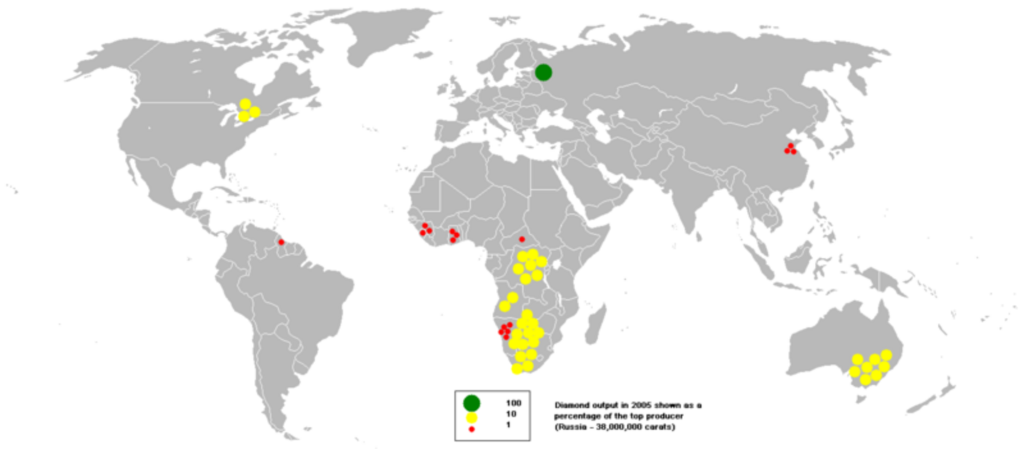
Diamond producing countries in the world play a major role in shaping the global gemstone and mining industry because diamonds remain one of the most valuable natural resources used in jewelry, technology, and industrial applications. While many nations are involved in mining, only a few countries dominate world production, consistently supplying the majority of rough diamonds that enter international markets. The global diamond industry is strongly influenced by these producers, with countries like Russia, Botswana, Canada, and several African nations contributing significantly to both the volume and value of diamonds mined each year. Understanding where diamonds come from and how much each country contributes provides a clear picture of the worldwide diamond supply chain, its economic impact, and its future prospects.
Table of Contents
- Introduction
- Meaning of Diamond Production
- Top 10 Diamond Producing Countries in the World
- Comparison Table of Top 10 Producers
- Other Diamond-Producing Countries in the World
- Characteristics of Global Diamond Production
- Challenges in Diamond Production
- Future of Diamond Production
- Conclusion
Meaning of Diamond Production
Diamond production refers to the process of extracting natural diamonds from the earth, sorting them into gem-quality and industrial-quality stones, and preparing them for trade on international markets. Production levels are usually measured in carats, where one carat equals 0.2 grams. The scale of production in a country is influenced by the size of its diamond reserves, the efficiency of mining technology, and the presence of large mining companies that can operate both open-pit and underground mines.
Natural diamond production is different from the growing industry of laboratory-created diamonds, which are synthesized through high-pressure high-temperature or chemical vapor deposition methods. In ranking countries by diamond production, only natural rough diamonds are considered, making it possible to identify the nations that lead the global supply.
Top 10 Diamond Producing Countries in the World
1. Russia – The World’s Leading Diamond Producer
Russia stands as the number one diamond producing country in the world, consistently contributing the largest share of global rough diamond output. The Yakutia region and the Arkhangelsk area host some of the most productive mines, operated mainly by the state-owned company Alrosa. Russia produces over 37 million carats annually, making it not only the biggest supplier by volume but also one of the most influential players in determining global diamond pricing.
2. Botswana – Africa’s Diamond Powerhouse
Botswana is the second-largest diamond producer globally and the leading producer in Africa. With mines such as Orapa, Jwaneng, and Letlhakane, the country produces around 25 million carats annually. Diamonds form the backbone of Botswana’s economy, accounting for a major portion of its export earnings and GDP. The partnership between the government and De Beers has allowed Botswana to manage its resources effectively, ensuring both high output and significant national revenue.
3. Canada – Cold Climate, Rich Mines
Canada has risen quickly to become the third-largest diamond producer in the world, despite entering the industry only in the 1990s. With major mines in the Northwest Territories and Ontario, Canada produces about 16 million carats annually. The country is also known for its strict environmental and labor standards, making Canadian diamonds attractive to ethically conscious buyers.
4. Angola – A Major African Contributor
Angola has established itself as a significant diamond producer with large mines like Catoca in the Lunda Norte region. Angola produces around 9 to 10 million carats annually, contributing strongly to Africa’s role in the global diamond industry. While much of its production is focused on rough diamonds, Angola continues to expand its mining capacity to increase its global ranking.
5. Democratic Republic of Congo – Industrial Diamond Giant
The Democratic Republic of Congo (DRC) is one of the top producers of industrial-quality diamonds. With production levels of about 8 to 9 million carats annually, the country has vast untapped reserves that could significantly boost its role in the global diamond industry. The Kasai region is the center of production, although much of the output is artisanal, making regulation and trade transparency a challenge.
6. South Africa – Historic Diamond Leader
South Africa is historically significant in the diamond industry because the global trade began with the discovery of the Kimberley mines in the 19th century. Today, South Africa produces about 5 to 6 million carats annually, with key mines including Venetia and Cullinan. While its production is lower than it was in the past, South Africa remains important because of its high-value gem-quality stones.
7. Zimbabwe – Rich but Controversial Fields
Zimbabwe contributes about 4 to 5 million carats annually, mainly from the Marange and Chiadzwa fields. While the country has rich diamond resources, its industry has often faced controversies related to transparency, ownership, and revenue distribution. Nonetheless, Zimbabwe remains one of Africa’s important producers, with potential for greater output in the future.
8. Namibia – Offshore Diamond Mining Leader
Namibia is unique because much of its diamond production comes from offshore marine mining along the Atlantic coast. The country produces about 2 million carats annually, and these diamonds are renowned for their high quality. The partnership between Namdeb and De Beers has allowed Namibia to develop advanced mining technologies, making it a global leader in offshore extraction.
9. Lesotho – Source of Large Gem Diamonds
Though smaller in volume compared to others, Lesotho produces around 0.7 million carats annually. Its Letseng mine is famous for yielding some of the largest high-quality diamonds ever discovered. This has given Lesotho a reputation for producing exceptional stones despite its relatively small overall output.
10. Sierra Leone – Famous for Gem-Quality Stones
Sierra Leone produces about 0.6 to 0.7 million carats annually and is well-known for its history of producing large, gem-quality stones. Although the country’s diamond industry has faced challenges related to conflict in the past, it continues to supply the global market with stones highly valued for jewelry.
Comparison Table of Top 10 Producers
| Rank | Country | Annual Production |
|---|---|---|
| 1 | Russia | ~37.3 million carats |
| 2 | Botswana | ~25.1 million carats |
| 3 | Canada | ~16.0 million carats |
| 4 | Angola | ~9.8 million carats |
| 5 | DRC | ~8.3–9.9 million carats |
| 6 | South Africa | ~5.9 million carats |
| 7 | Zimbabwe | ~4.5 million carats |
| 8 | Namibia | ~2.1–2.3 million carats |
| 9 | Lesotho | ~0.7 million carats (≈700,000 carats) |
| 10 | Sierra Leone | ~0.6–0.7 million carats (≈600,000–700,000 carats) |
Other Diamond-Producing Countries in the World
Beyond the top ten producers, several other countries contribute smaller but still significant amounts of rough diamonds to the global market. These nations may not dominate in terms of volume, but they play important roles in regional economies and supply chains. Some of them are historically known for diamond discoveries, while others have emerging industries that are steadily growing.
- Ghana – Produces hundreds of thousands of carats annually, mainly through small-scale and artisanal mining.
- Tanzania – Known for both diamonds and other gemstones, with output in the hundreds of thousands of carats per year.
- Brazil – Once a leading global producer in the 18th century, Brazil now contributes smaller amounts, in the range of hundreds of thousands of carats.
- India – Historically famous for diamond discoveries like the Koh-i-Noor, but today only produces limited volumes of rough diamonds.
- Guyana and Venezuela – Both South American countries mine diamonds at modest scales, often tens to hundreds of thousands of carats.
- Central African Republic – Contributes a few hundred thousand carats yearly, mostly from artisanal mining.
- Guinea – Produces hundreds of thousands of carats annually, mostly low-to-medium quality stones.
While their production is smaller compared to giants like Russia, Botswana, or Canada, these countries add diversity to global diamond sourcing and often specialize in unique qualities of stones.
Other Diamond-Producing Countries in the World
| Country | Annual Production (Approx.) | Notes |
|---|---|---|
| Ghana | ~300,000–400,000 carats | Mostly artisanal and small-scale mining |
| Tanzania | ~200,000–300,000 carats | Known for both diamonds and colored gemstones |
| Brazil | ~150,000–200,000 carats | Once a global leader, now a minor producer |
| India | ~100,000–150,000 carats | Historically significant, now limited output |
| Guyana | ~100,000–150,000 carats | Small-scale river mining |
| Venezuela | ~100,000–200,000 carats | Production has declined in recent years |
| Central African Republic | ~300,000–400,000 carats | Mostly artisanal mining |
| Guinea | ~500,000–600,000 carats | Produces mostly lower-grade stones |
Characteristics of Global Diamond Production
Global diamond production is marked by a few important characteristics that make the industry unique compared to other mineral sectors. First, the industry is highly concentrated, with just a handful of countries accounting for the vast majority of supply. For example, Russia, Botswana, and Canada together account for more than half of global output. Second, diamond quality varies widely, with some nations producing mainly gem-quality stones suited for jewelry, while others such as the Democratic Republic of Congo focus heavily on industrial diamonds used in cutting, drilling, and grinding.
Another characteristic is the regional dominance of Africa, which remains the single most important continent in global production. Countries like Botswana, Angola, South Africa, Namibia, and Zimbabwe contribute massively to Africa’s position as the heart of the diamond trade. In contrast, producers like Canada and Russia dominate in the Northern Hemisphere.
Finally, diamond production is tied to major international mining companies, such as Alrosa, De Beers, and Rio Tinto, which control large-scale operations. However, artisanal and small-scale mining also plays a big role, particularly in African nations, contributing to employment but also posing challenges in terms of regulation and sustainability.
FAQ On Top 10 Diamond Producing Countries in the World
1. Which country is the largest producer of diamonds in the world?
Russia is the largest producer of diamonds in the world, with an annual output of about 37.3 million carats.
2. Which countries produce the highest quality diamonds?
Botswana, Canada, and Lesotho are well known for producing high-quality gem-grade diamonds.
3. How many countries produce diamonds globally?
More than 25 countries produce diamonds, but the top 10 account for the majority of global production.
4. What are the top 3 diamond producing countries in the world?
The top three diamond producing countries are Russia, Botswana, and Canada.
5. Which countries in Africa are among the top 10 producers worldwide?
Botswana, Angola, Democratic Republic of Congo, South Africa, Namibia, Zimbabwe, Sierra Leone, and Lesotho are part of the top 10 global producers.
6. Which country in South America produces diamonds?
Brazil is the leading South American producer, though on a smaller scale compared to Africa and Russia.
7. What is the difference between industrial and gem-quality diamonds?
Industrial diamonds are used in industries for cutting and drilling, while gem-quality diamonds are polished for jewelry.
8. How much diamond does Canada produce annually?
Canada produces about 16 million carats annually, ranking third in the world.
9. Which country is unique for marine diamond mining?
Namibia is unique because most of its diamonds are mined offshore from the Atlantic seabed.
10. Will global diamond production continue to grow?
Yes, though growth may be slow, with technological mining advances and exploration in countries like Angola and Canada expected to increase future output.
RELATED ARTICLES
- Top 10 Gold Producing Countries in the World – In Metric Tons
- Top 10 Diamond Producing Countries in Africa and Their Output