
The plant cell is a basic topic in biology that helps students understand how plants are structured and how they carry out vital life processes. Just like animals, plants are made up of cells, but plant cells possess unique features that enable them to manufacture their own food through photosynthesis. A clear understanding of the plant cell, its types, structure, and functions is essential for explaining plant growth, nutrition, and survival.
Table of Contents
- Introduction
- Definition of a Plant Cell
- Types of Plant Cells
- Structure of a Plant Cell
- Functions of Plant Cell Organelles
- Diagram of a Plant Cell (Description)
- Conclusion
- Frequently Asked Questions (FAQs)
Definition of a Plant Cell
A plant cell is the basic structural and functional unit of a plant, capable of carrying out all essential life activities such as respiration, growth, excretion, and photosynthesis. Plant cells are eukaryotic, meaning they contain a true nucleus and membrane-bound organelles. Unlike animal cells, plant cells have a rigid cell wall, chloroplasts, and a large central vacuole, which help maintain shape and support food production.
Types of Plant Cells
Plant cells are specialized to perform different functions within the plant body. These cells work together to form tissues and organs.
Meristematic cells are actively dividing cells found in growing regions such as root and shoot tips, and they are responsible for plant growth. Permanent cells develop from meristematic cells and may be specialized for specific functions. Examples include parenchyma cells for storage and photosynthesis, collenchyma cells for support and flexibility, and sclerenchyma cells for strength and rigidity. Vascular cells, such as xylem and phloem cells, are involved in the transport of water, minerals, and food substances.
Types of Plant Cells In Details
1. Meristematic Cells
- These are actively dividing cells found in growing regions such as root and shoot tips.
- They are responsible for plant growth and development.
2. Parenchyma Cells
- These are simple, thin-walled cells involved in storage, photosynthesis, and tissue repair.
- They are the most common type of plant cells.
3. Collenchyma Cells
- These cells have unevenly thickened walls and provide flexible support to growing parts of the plant.
4. Sclerenchyma Cells
- These cells have thick, lignified walls and provide strength and rigidity to mature plant parts.
- They are usually dead at maturity.
5. Xylem Cells
- Xylem cells form part of the vascular tissue and are specialized for transporting water and minerals from roots to other parts of the plant.
6. Phloem Cells
- Phloem cells are also vascular cells responsible for transporting food (mainly sugars) from leaves to other parts of the plant.
Structure of a Plant Cell
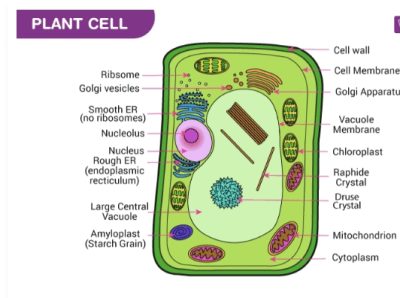
The structure of a plant cell consists of several organelles, each with a specific function that contributes to the overall survival of the plant.
The cell wall is a rigid outer covering made mainly of cellulose, which provides protection and maintains the shape of the cell. Beneath the cell wall is the cell membrane, which controls the movement of substances into and out of the cell. The cytoplasm is a jelly-like substance where most metabolic activities take place and where cell organelles are suspended.
The nucleus controls all cell activities and contains genetic material responsible for inheritance. Chloroplasts are green organelles that contain chlorophyll and are the sites of photosynthesis. Mitochondria release energy through respiration, while the large central vacuole stores water, food substances, and waste products, helping to maintain turgidity in plant cells.
Functions of Plant Cell Organelles
Each organelle in a plant cell performs a specific function necessary for plant survival. The cell wall provides support and protection, while the cell membrane regulates material exchange. Chloroplasts trap light energy for photosynthesis, producing glucose for the plant. Mitochondria release energy needed for growth and repair. The vacuole maintains internal pressure and stores useful substances, and the nucleus coordinates cell division and activities.
Diagram of a Plant Cell (Description)
A typical plant cell diagram shows a rectangular-shaped cell with a thick outer cell wall, a thin cell membrane just inside it, and a large central vacuole occupying most of the cell space. The nucleus is usually pushed to the side due to the large vacuole, while chloroplasts appear as oval green structures scattered in the cytoplasm. Other organelles such as mitochondria and ribosomes are also present and clearly labeled in standard biology diagrams.
Frequently Asked Questions (FAQs)
1. Why do plant cells have a cell wall while animal cells do not?
Plant cells have a cell wall to provide rigidity, protection, and support, helping plants maintain their shape and stand upright, while animal cells rely on other structures for support.
2. What is the role of chloroplasts in plant cells?
Chloroplasts are responsible for photosynthesis, where light energy is converted into chemical energy in the form of glucose.
3. Why is the vacuole large in plant cells?
The large vacuole stores water and helps maintain turgidity, which keeps the plant firm and prevents wilting.
4. Are all plant cells capable of photosynthesis?
No, only plant cells that contain chloroplasts, such as leaf mesophyll cells, can carry out photosynthesis.
5. What is the difference between meristematic and permanent plant cells?
Meristematic cells actively divide and cause growth, while permanent cells are specialized for specific functions and do not divide frequently.
6. How is a plant cell adapted for its functions?
Plant cells are adapted through structures like chloroplasts for food production, a cell wall for support, and a vacuole for storage and pressure regulation.
STUDY ALSO: Photosynthesis in Plants: Definition, Process, Factors
The plant cell is a complex but well-organized unit that enables plants to grow, produce food, and survive in different environments. By understanding the definition, types, structure, and functions of the plant cells, students gain a solid foundation for studying plant physiology, ecology, and other branches of biology.